Facade Maintenance: Balancing Cost, Safety and Longevity
Regular facade maintenance is a non-negotiable requirement for high-rise buildings in the Middle East. Harsh environmental conditions, including intense solar radiation, dust storms, and occasional rain, accelerate wear on cladding, glazing, sealants, and structural components. Without systematic inspection and upkeep, minor defects can lead to water ingress, glass failure, or loose panels that pose safety risks to occupants and pedestrians.
Choosing between temporary access methods and permanent installed systems is a foundational decision that affects cost, safety, and the effective lifespan of the facade. Temporary equipment such as scaffolding, bosun’s chairs, and suspended platforms offers lower upfront investment but carries operational limitations that can add to long-term expense. Permanent solutions like building maintenance units (BMUs), monorails, and roof-mounted cradles require higher initial capital but reduce ongoing labour and recertification costs.
The correct trade-off depends on the building’s design complexity, the required frequency of maintenance, and the available budget. A tailored approach that matches equipment specifications to the actual maintenance programme prevents both overspending on unnecessary capacity and underspending that leaves facade areas inaccessible. Early-stage coordination between architects, engineers, and facade access specialists is needed to ensure the chosen system fits the building’s geometry without compromising architectural intent or safety compliance.
Permanent BMUs: The Default for Tall, Complex Facades
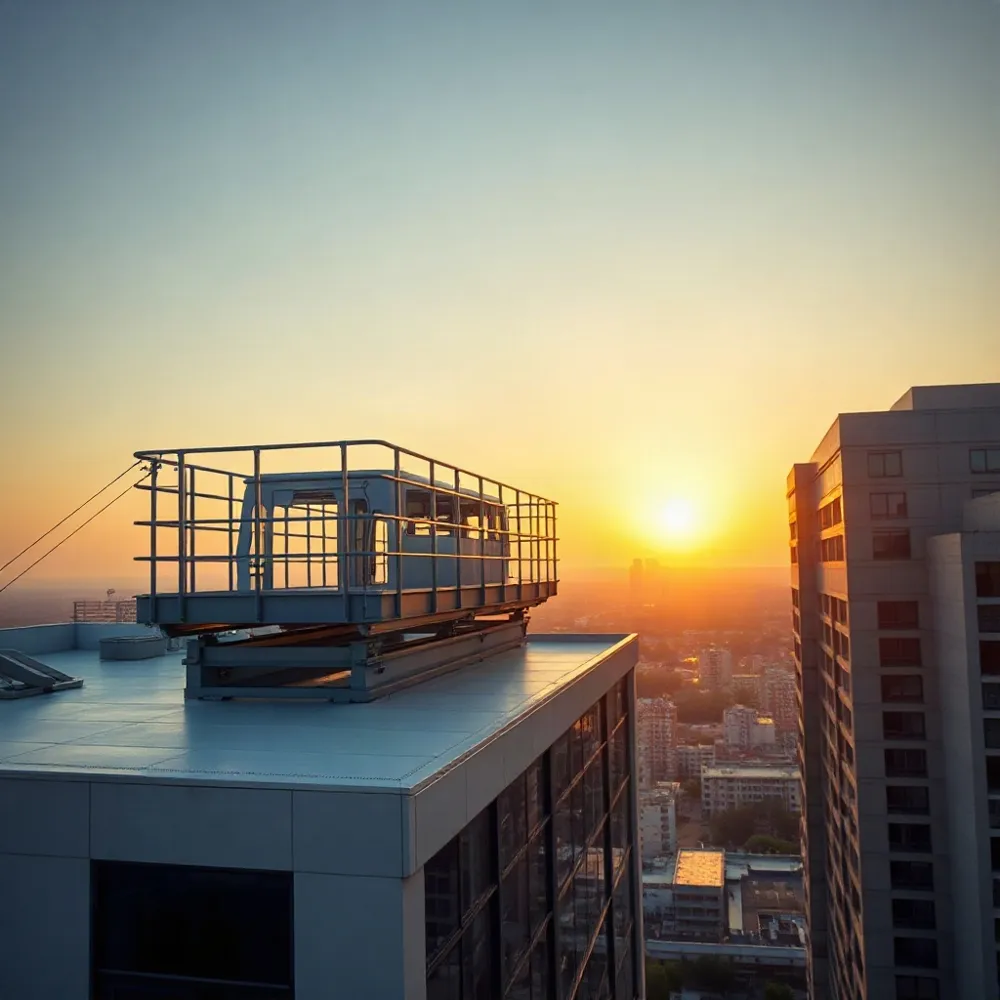
A Building Maintenance Unit (BMU) is a permanent, custom-built system that carries a gondola both vertically and horizontally along roof-mounted tracks. Unlike temporary solutions, the BMU becomes part of the building’s infrastructure and requires no disassembly or re-certification between uses.
Once a building exceeds 300 feet (91 meters) in height, suspended platform systems become impractical because their hoists must remain at roof level and horizontal repositioning demands time-consuming detachment and re-certification by a competent person. For these tall structures, the BMU is the default choice: it can travel laterally across the roof and then descend the facade in a single, controlled motion, covering wide areas efficiently.
BMUs also handle facades that slope inward, outward, or twist, thanks to rotating booms, telescopic masts, and extending gondolas. When parked, many BMU designs can be retracted into a roof-mounted cradle or hidden behind a parapet, preserving the building’s architectural appearance.
Operationally, a BMU requires only an annual service and certification. Workers step into a pre-installed, factory-tested gondola and do not need to assemble or certify the suspension rig each time, which reduces the risk of installation errors and lowers the likelihood of incidents.
Sea Star Engineering designs and installs permanent BMUs for high-rise projects across the Middle East, with a custom approach that tailors the track layout, boom reach, and gondola configuration to each building’s facade geometry. The company also retrofits existing structures, assessing roof load capacity and integrating a permanent system where only temporary access was previously available.
Temporary Options: Bosun’s Chair, Davits, and Swing Stages
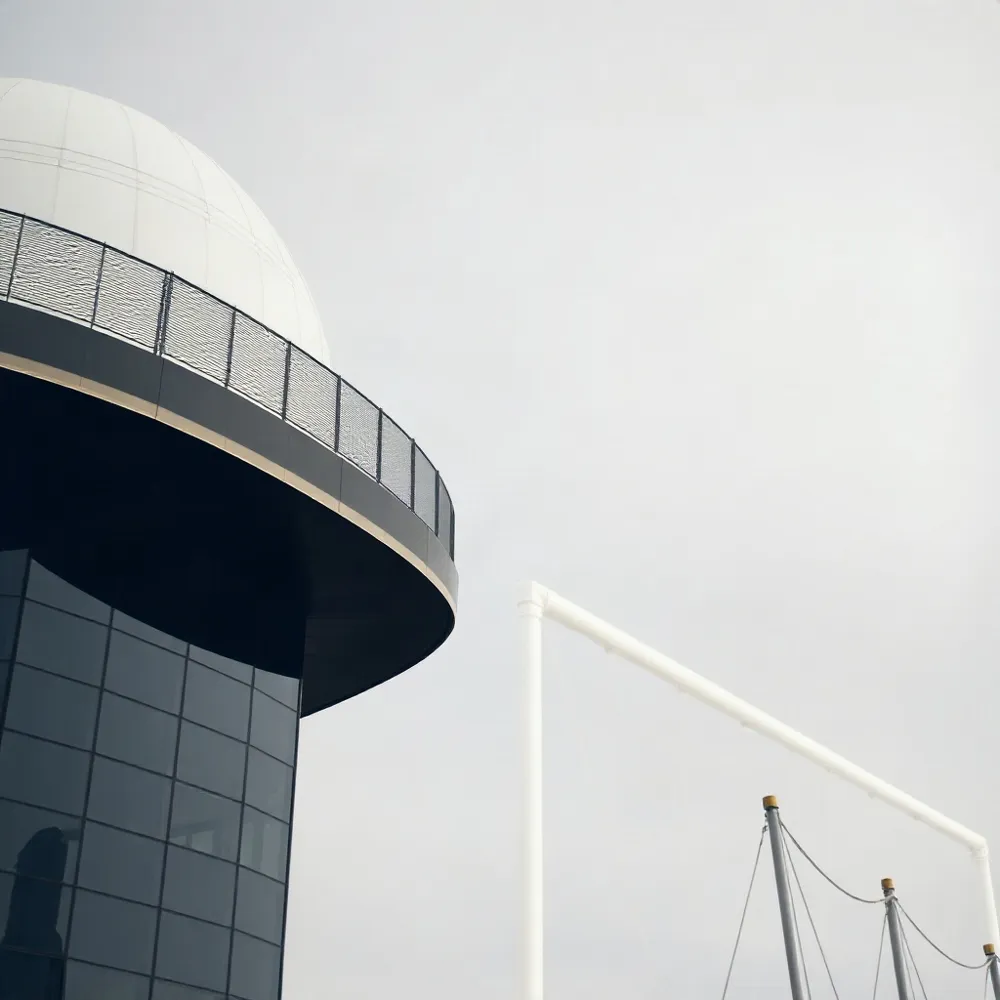
Temporary facade access systems are often the first choice for projects with limited scope, infrequent maintenance schedules, or tight budgets. They require lower upfront investment compared to permanent installations, but they come with operational trade-offs in reach, safety, and labor cost.
Bosun’s Chair. A single-person plank suspended by rope from the roof, offering the lowest initial cost of any access method. The work area is limited to the user’s arm’s reach, making it suitable only for narrow, straight facades with low maintenance frequency. Extensive training is required, and qualified workers command higher rates. On wide facades that require regular maintenance, multiple chairs are needed, quickly erasing the cost advantage. Suspended Platform. Also called a swing stage, this system hangs a platform (up to 52 ft long) from davit arms, outrigger beams, or parapet clamps. Two workers can operate simultaneously, covering large areas in a single vertical pass. Platforms can serve low‑, mid‑, and high‑rise buildings, though once vertical travel exceeds about 300 ft, a BMU becomes the more practical choice. A significant drawback: horizontal repositioning requires detaching the platform and recertification by a competent person, making it time-consuming.Davit System. An economical, movable solution in which davit arms are stored on the roof and deployed only when needed. Davits are often teamed with modular suspended platforms up to 12 m in span. They work well for buildings that need occasional access, but they are not ideal for long facades or curved or inclined roofs because repositioning the davits across the roof adds setup time and cost.MEWP. Mobile Elevated Work Platforms (cherry pickers, bucket trucks) are ground‑based and do not require roof infrastructure. Their height and outreach capacity are limited, and cost rises steeply with required height. They are best suited for low‑rise buildings with adequate ground space, where the platform can be driven close to the facade.
When Permanent Access Outperforms Temporary Systems
For buildings with large facade areas that require frequent scheduled maintenance, a BMU delivers lower total cost despite the higher initial investment. Maintaining a wide facade with multiple bosun’s chairs or swing stages repeatedly drives up worker costs and setup time. A permanent BMU requires only annual service and certification, and operators need training only in system operation, not in rigging and dismantling each use.
Complex building shapes — inward or outward sloping facades, twisting profiles, and protruding elements — are difficult or impossible to service efficiently with temporary systems. Swing stages and bosun’s chairs lose horizontal travel during descent, demanding disconnection, anchor repositioning, and recertification by a competent person at each work zone. A custom BMU can be designed with rotating booms, extending gondolas, and soft rope systems to follow the building contour without repositioning delays.
For buildings that will be maintained over several decades, the lifecycle cost of a permanent system is almost always lower if maintenance is regular. Sea Star Engineering designs, supplies, and installs purpose-made BMUs tailored to each building’s geometry and local code requirements, turning a high upfront investment into a predictable, lower-cost maintenance program over the building’s life.
When Temporary Access Remains the Right Choice
While permanent BMUs are the gold standard for tall, complex facades with frequent maintenance schedules, temporary access solutions such as bosun’s chairs, davits, and swing stages remain the best fit for a distinct set of project profiles. The key is matching the system to the building’s actual demand without over-engineering the access strategy.
Low-Frequency Maintenance and Limited Scope
Projects where the facade is narrow, straight, and requires only occasional cleaning or inspection can avoid the significant upfront investment of a permanent BMU. A bosun’s chair, for instance, requires minimal equipment cost and works well for steep, simple vertical facades where a single trained worker can cover the entire surface in a single descent. The trade-off is that the user needs extensive training, and qualified rope-access technicians are relatively expensive per hour.
For slightly wider facades, a suspended platform system (swing stage) supported by davit arms or outrigger beams allows two workers to operate simultaneously, covering a larger area in one vertical pass. Platforms range from 3 to 52 feet in length, making it practical for mid-rise buildings where a BMU would be cost-prohibitive. However, horizontal repositioning requires detaching the platform and recertification by a competent person, so the system is best suited to straight, uninterrupted facade runs.
Construction-Phase and Short-Term Renovations
During the construction phase or a short-term renovation, a permanent system may not yet be justified. In new builds, temporary access solutions handle the finishing and cladding stage before the building’s permanent access equipment is installed. Sea Star Engineering’s Rental Cradles offer a flexible, temporary alternative that reduces upfront capital strain while still providing safe, reliable access for facade work. For occupied building refurbishments, the company’s purpose-made temporary cradles allow window replacement without disrupting tenants — a practical bridge between the project phase and permanent installation.
Historic and Restricted Structures
Historic buildings or those with conservation-area restrictions often prohibit the installation of roof-mounted permanent equipment such as BMU rails or heavy telescopic cars. In these cases, lightweight davit systems that can be stored away when not in use, or personal suspension systems (rope access), become the only viable options. Rope access allows workers to descend, ascend, and traverse freely around intricate stonework or protruding elements without altering the building’s silhouette. OSHA restricts rope descent systems for heights greater than 300 feet, and several European guidelines impose similar limits, so these systems are most appropriate for low- to mid-rise heritage structures.
Specialized Access for Difficult Zones
Complex building features such as deep atriums, glass roofs, or inward-sloping sections may not be reachable by fixed gantries or standard monorails without custom engineering that far exceeds the project budget. Mobile Elevated Work Platforms (MEWPs) are a practical ground-based option for facades up to several stories, but their cost rises steeply with height and outreach. For confined or unusually shaped zones — such as skylights, sloped glass roofs, or ornamental details — rope access remains the most adaptable solution, though it is relatively slow and can be expensive over large areas due to high technician costs.
| Temporary System | Best Use Case | Limitations |
|---|---|---|
| Bosun’s chair | Narrow, straight facades; low frequency | Slow; high per-worker cost; limited to one person |
| Suspended platform (swing stage) | Mid-rise; straight facades; two workers | Slow horizontal repositioning; not for sloping facades |
| Davit system | Heritage buildings; removable storage | Not ideal for long or curved facades |
| Rope access | Ornamental details; hard-to-reach zones | Height limits; slow coverage; expensive over large areas |
| MEWP (cherry picker) | Low-rise; adequate ground space | Cost rises fast with height and outreach |
Planning for Retrofits and Existing Buildings
Retrofitting permanent access equipment in existing structures starts with a structural capacity assessment. The building’s roof and facade system may not have been designed for the loads of a modern BMU or monorail. An engineer must evaluate whether the roof can support the track system, the counterweight, and the gondola before any custom fabrication begins.
Solving the Temporary Access Trap
Many existing buildings rely on temporary access because maintenance requirements were not considered during original construction. This becomes inefficient over time. A permanent retrofit solves that problem. Retrofit also improves safety, extends equipment lifespan, and brings older properties up to modern standards without changing the building’s appearance.
When planning a retrofit, the key variables are facade geometry, roof capacity, and budget. A simple standard BMU running on rooftop tracks can cover a flat-roofed building efficiently. For curved facades or complex architectural layouts, a custom BMU or telescopic roof car may be necessary.
Safety and Compliance Across Systems
Every facade access system operates within a defined safety framework. For permanent systems, the European standard EN1808 covers both permanently installed BMUs and temporary suspended platforms, establishing load testing, structural design, and emergency descent requirements.
Rope access methods face stricter height limitations. OSHA restricts rope descent systems for heights greater than 300 feet (91 m). In the UK, BS 7985:2013 provides the code of practice for rope access where ropes serve as the primary means of support and fall protection. For permanently installed suspended access equipment, BS 6037-1:2017 guides planning, design, installation, and use.
A permanent BMU reduces incident risk compared to a bosun’s chair because operators require training on the specific machine but do not need installation knowledge for each deployment. All systems demand regular inspection. BMUs should be inspected at least once a year, and more frequently depending on usage, climate, and local codes.
Customisation and Aesthetics in High-End Projects
Modern architecture in the Gulf often features complex geometries, curved cladding, and angled rooflines that challenge standard facade access equipment. A permanently installed solution must deliver full coverage without compromising the building’s visual lines.
A Building Maintenance Unit (BMU) can be designed to vanish when not in use. Telescopic roof cars retract into a roof penthouse, and overhead trollies park flush with the roofline, preserving the clean silhouette that architects specify. For curved facades, angled rooflines, or protruding elements, custom BMUs with rotating booms, extending gondolas, and soft rope attachments match the building’s geometry while maintaining safety standards.
Custom-design approaches are available to produce individual solutions for each building’s geometry across the UAE and GCC. Purpose‑made cradles allow window replacement in occupied buildings, integrating access equipment with ongoing operations.
Monorail systems offer an alternative where roof space is tight, weighing just 3.6–8 kg/m and blending into complex building profiles. Their light footprint suits high-end projects that demand unobtrusive maintenance access without sacrificing structural capacity.
Matching Equipment to Project Phase and Budget
Matching a facade access system to the project phase and budget requires early collaboration between architects, facility managers, and specialist suppliers. A BMU is a capital investment that pays back over decades of reduced labour costs and downtime, while temporary solutions such as bosun’s chairs or suspended platforms are operational expenses better suited to short-term or low-frequency needs. Consulting facade access specialists early ensures the chosen system aligns with the building’s height, facade area, and maintenance schedule.
Specialist suppliers provide a complete service for permanent access equipment including design, supply, installation, operator training, and ongoing maintenance. For new high-rise projects, a custom BMU is a long-term asset that can be hidden when parked, preserving architectural aesthetics while enabling safe, efficient access to every part of the facade. When maintenance is frequent and the facade area is large, the BMU’s lower ongoing worker costs quickly offset its initial outlay.
One real-world example is window replacement in an occupied building. Purpose-made permanent cradles have been used for this exact scenario, reducing tenant disruption and avoiding the lengthy setup and dismantling costs of temporary scaffolding or swing stages. The permanent system allows work to proceed floor by floor without blocking access or requiring extensive re-certification between moves.
Decision Factors for Different Profiles
Large facade area, frequent maintenance. A permanent BMU delivers the lowest total cost of ownership. Its horizontal and vertical travel covers wide facades without repositioning delays, and annual certification is the only recurring expense.Narrow facade, low-frequency maintenance. A bosun’s chair or a temporary suspended platform (swing stage) provides adequate access with minimal upfront investment. Qualified personnel are required, and horizontal repositioning adds time, but for infrequent tasks this is acceptable.Retrofit or existing building. Upgrading to a permanent system should be evaluated when the facade requires regular access. A retrofitted BMU improves safety, extends equipment lifespan, and brings the property up to modern standards without compromising the building’s structural integrity.
For temporary projects such as construction-phase access or short-term renovations, rental cradles offer a flexible operational expense model that reduces upfront capital strain and eliminates the overhead of equipment storage and long-term certification.
Investing in Safety and Efficiency for the Long Term
Selecting the right facade access system comes down to the building’s profile. Permanent BMUs suit tall, complex facades with frequent maintenance needs, while temporary systems like bosun’s chairs or swing stages work for short-term, low-frequency, or constrained projects. Early decision-making prevents costly retrofits and operational disruptions.
Sea Star Engineering delivers both temporary and permanent access capabilities, with a core focus on permanent BMUs, purpose-made cradles, and waste chute solutions. The company’s custom-design approach ensures equipment matches the building’s geometry and maintenance schedule, reducing long-term costs compared to repeated temporary setups.
Partnering with specialists early in the design phase allows architects and facility managers to integrate safe, code-compliant access from the start. For building owners across the Middle East, that collaboration translates into equipment that preserves facade aesthetics, meets local safety standards, and supports efficient maintenance for decades to come.